
Parrot Disco FPV 11.1V 10000mAh Li-ion battery upgrade
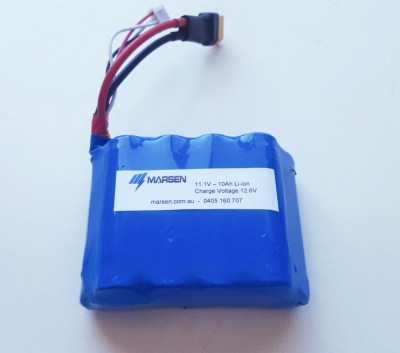
Parrot Disco FPV 11.1V 10000mAh Li-ion battery upgrade
Parrot Disco FPV 11.1V 10000mAh
The Parrot Disco FPV 11.1V 10000mAhk is engineered for pilots who demand longer flight times and reliable performance. Designed as a direct replacement and upgrade for the stock Parrot battery, this high-capacity Li-ion pack delivers extended range, reduced downtime, and consistent power output.
Built with premium lithium-ion cells, this battery is lightweight yet powerful, maximising efficiency while maintaining a safe discharge profile. Ideal for FPV enthusiasts, professional aerial photographers, and survey operators, this upgrade ensures you spend more time in the air and less time recharging.
$125.00
Out of stock
Out of stock
Specifications
Parrot Disco FPV 11.1V 10000mAh
- Capacity: 10Ah/10000mAh
- Nominal Voltage: 36V
- Discharge current: 30 Amps
- Standard Charge: 2 Amps
- Fast Charge: 4 Amps
- Charge Voltage: 12.6V
- Weight: 460g
- Dimensions: 375mm x 140mm x 19mm
Applications
Parrot Disco FPV 11.1V 10000mAh- How the Disco measures battery level
Many RC flight controllers with battery monitoring use a current sensor to measure how much energy is removed from the battery.
The Disco has no current sensor. Instead it monitors the battery voltage under load to figure out how much is left. This method has the advantage of the Disco not needing to know how large the battery is or how fully charged it was, to figure out how many percent capacity is left. The method has the disadvantage that it cannot know how much actual capacity is left, only how many percent.
When the motor runs on full power, the battery voltage temporarily drops. When the motor power is reduced, the battery voltage recovers. This is normal, and more pronounced in li-ion batteries than li-po. It means the battery voltage goes up and down all the time, depending on how much power you use.
To prevent the battery percentage display going up and down all the time, The Disco firmware only shows the lowest value it has measured. Any subsequent voltage recovery will not be shown. This can have unintuitive effects.
If you for example climb very high at the beginning of a flight, your battery level may drop rather quickly. Once you reach your altitude and start cruising, the battery level shown will stop falling and will remain on the lowest level you reached. It can be “stuck” there for quite some time.
This “battery level stuck” effect can also be seen with cold batteries. Cold batteries drop their voltage under load more than warm batteries, due to increased internal resistance. But batteries under load warm up, causing the battery voltage to in some cases actually rise with increased use! This too will result in the Disco user interface showing the battery level being stuck on the same value for longer than expected.
Software configuration for custom batteries
When using a li-ion battery pack, you don’t have to change any parameters. But if you don’t, the Disco will think you are still using a lipo and not use the whole capacity of your battery.
To use all of your capacity and to get proper % remaining reading with these packs, you need to change the voltage table the Disco uses to calculate battery state.
Configuration parameters
Here are the parameters related to battery voltage you need to change. First is a list of voltage levels for various warnings and limits.
# BATTERY
BATTERY_FILTER_CO_HZ = 1.0
VBAT_MIN = 8.8
VBAT_LOW = 8.9
VBAT_SHUTDOWN = 8.3
#/////////////////////////////////////////////////////////////
# PREFLIGHT
PREFLIGHT_BATTERY_LOW_LEVEL = 10
#/////////////////////////////////////////////////////////////
# SAFETY
SAFETY_GROUND_PROXIMITY_CHECK_ENABLED = true
# Battery voltage below which a warning is emitted.
SAFETY_LOW_BATTERY_VOLTAGE = 9.0
# Battery voltage below which a critical failure is reported.
SAFETY_CRITICAL_BATTERY_VOLTAGE = 8.5
# Battery voltage above which a EMPTY BAT failure is cancelled
SAFETY_UNCRITICAL_BATTERY_VOLTAGE = 9.3
# Battery voltage below which a warning is emitted.
SAFETY_LOW_BATTERY_PERCENT = 9.6
#Battery voltage below which a critical alert is emitted.
SAFETY_CRITICAL_BATTERY_PERCENT = 0
Cell specific battery tables
You also need to change the battery percentage table to get an accurate reading. The table is slightly different for different battery packs, depending on the number and type of li-ion cells used.
Note! These tables are designed to let you use your battery to the fullest. There is very little “reserve” below 0% battery. Even before reaching 0%, your motor may produce less thrust and climb poorly due to the low voltage. Plan your flights accordingly.
Additional information can be found at:
https://github.com/uavpal/disco-docs/wiki/batteries
3s3p packs:
BATTERY_PERCENTAGE_TABLE_LENGTH = 20
BATTERY_PERCENTAGE_TABLE_VOLTAGE = 8.5, 8.67, 8.81, 8.94, 9.17, 9.34, 9.51, 9.67, 9.81, 9.92, 10.1, 10.25, 10.83, 11.51, 11.69, 11.88, 11.98, 12.07, 12.17, 12.41
BATTERY_PERCENTAGE_TABLE_PERCENTAGE = 0, 1, 2, 3, 5, 7, 9, 11, 13, 15, 20, 25, 50, 75, 80, 85, 90, 95, 98, 100
Important Information
Parrot Disco FPV 11.1V 10000mAh
- Care of your battery – Important Information
- Do not expose to heat.
- Never use force to install (insert) Li-ion battery.
- Do not short (connect) positive and negative battery terminals. Keep battery that is not in use in an insulating container.
- Store in cool and dry place.
- Charge fully before first use.
- Use only a high-quality battery charger.
- Never completely discharge Li-ion battery.
- Do not charge unattended unless using an intelligent charger that shuts off at full charge.
- Do not store your Li-ion batteries fully charged (for extended period).
- After battery is discharged do not leave it discharged, charge it as soon as possible.
When storing a battery for an extended period, follow the instructions below
- Keep battery packs in a cool, dry, and well-ventilated area, away from direct sunlight, heat sources, and flammable materials.
- Store them at around 40–60% capacity. Avoid storing them fully charged or completely depleted, as this helps reduce stress and long-term degradation of the cells.
- Lithium-ion batteries naturally self-discharge over time. Check the voltage periodically and recharge if it drops below safe levels to prevent deep discharge damage.
Related products
-
 Quick View
Makita BL1830 18650 18V 6Ah Replacement Battery
$175.00 -
Sale!
 Quick View
50.4V 4A Charger for 12S Lithium Ion Battery Packs
Original price was: $97.50.$85.00Current price is: $85.00. -
 Quick View
Makita BL1830 21700 18V 4Ah Replacement Battery
$138.00 -
 Quick View
42V 4A Charger for 10S Lithium Ion Battery Packs
$97.50 -
 Quick View
DeWalt DCB200 18V 3Ah Replacement Battery
$90.00 -
 Quick View
DeWalt DCB200 21700 18V 4Ah Replacement Battery
$120.00